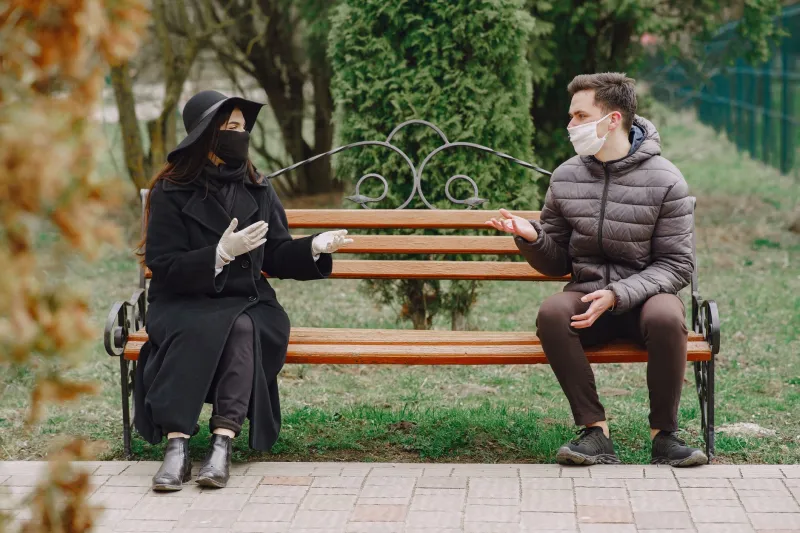
We've Turned Making Friends Into a Job Application Process

Remember when you made a best friend because you sat next to each other on the bus? Or because you both reached for the last slice of pizza at a party and decided that was enough of a foundation to build something on? That kind of accidental, chaotic, no-vetting-required friendship feels almost quaint now. Almost naive.
Because somewhere in the last several years, a whole lot of us stopped letting friendships just happen. We started running people through a process. Not a formal one, obviously — nobody's handing out friendship applications at brunch. But the mental checklist? It's very real, and it's getting longer.
The Invisible Intake Form
Here's what the modern friendship pre-screening looks like, if we're being honest about it. You meet someone interesting. Maybe at work, maybe through a mutual, maybe in the comments section of a podcast episode about emotional intelligence (which, yes, is a thing that happens now). And before you even consider grabbing coffee, you're already running through a quiet little questionnaire in your head.
Do they vote the way I vote? Do they have the same relationship with therapy that I do? Are they the kind of person who'll respect my boundaries, or are they going to be a lot? Do they have drama? What kind of drama? Is their communication style compatible with mine? Are they in a season of growth, or are they still doing the same thing they were doing five years ago?
It's exhaustive. And the wild part is, most of us don't even clock that we're doing it.
We've absorbed so much language around self-protection and intentional living that the vetting process has become second nature. We talk about "curating our circle" the way we talk about curating a playlist — like the whole point is to get the vibe exactly right, and anything that disrupts the aesthetic has to go.
Where This Came From
This didn't come from nowhere. A few things collided to get us here.
First, therapy became mainstream in a way it genuinely hadn't been before — and with it came a whole vocabulary around attachment styles, red flags, emotional labor, and the concept of people being "safe" or "unsafe." That framework is genuinely useful. It's also incredibly easy to weaponize against perfectly decent people who just haven't read the same books you have.
Then the pandemic hit and basically ran a factory reset on everyone's social lives. We had months, sometimes years, of existing in tiny, controlled social bubbles. And a lot of people discovered — not without some guilt — that they kind of liked it. The quiet. The low-maintenance of it. The not having to show up for people constantly. Coming back out into the world of full-contact friendship felt like a lot, and we started being more selective about who was worth the effort.
And then there's social media, which trained us to think of connection as something you opt into deliberately. You follow people on purpose. You unfollow them on purpose. Relationships have an interface now, and we've started applying that logic to real life.
The Case For Being Selective
Okay, but let's be fair — some of this is actually good.
For a long time, especially for women and for people in marginalized communities, the cultural pressure was to be endlessly available, endlessly accommodating, endlessly forgiving of people who consistently took more than they gave. "You don't just throw people away" was the wisdom, even when the people in question were quietly draining the life out of you.
Being more intentional about who gets access to your inner world isn't inherently cold or calculating. It can be a form of self-respect. Knowing what you need in a friendship — reciprocity, honesty, emotional availability — and actually holding out for it isn't the same thing as being incapable of connection.
There's also something to be said for the friendships that form when two people are genuinely aligned. When you skip the years of quietly tolerating incompatibility and land in a friendship that actually fits, it can be profound. Efficient, even, in the best possible way.
The Case Against Yourself
But here's where I want to push back a little, because I think we're also using "intentionality" as a cover for something less flattering.
Sometimes the checklist isn't about protection. It's about control. It's about wanting relationships that never challenge us, never make us uncomfortable, never require us to grow in directions we didn't pre-approve. When everyone in your circle thinks exactly like you, processes emotions exactly like you, and has exactly the same relationship with conflict that you do — that's not a community. That's an echo chamber with a group chat.
And the other thing nobody wants to say out loud: the hyper-selective approach to friendship is a privilege. It requires that you already have enough people in your life that you can afford to be picky. For a lot of people — people who just moved to a new city, people who aged out of institutional social structures like school or organized religion, people who are just genuinely lonely — the luxury of a rigorous vetting process is kind of a joke. You take connection where you find it, or you don't have it at all.
There's also the simple fact that some of the most important friendships in people's lives are the ones that surprised them. The person who didn't pass the vibe check on paper but turned out to be exactly who you needed. The friendship that started with friction and became something irreplaceable. You can't algorithm your way to that.
What We're Actually Protecting
I think the real question underneath all of this is: what are we so afraid of?
Because the friendship resume, the compatibility screening, the careful management of who gets close — it's all, at its core, a defense mechanism. And defense mechanisms exist for a reason. Most of us have been hurt. We've invested in people who didn't invest back. We've been the one who cared more, showed up more, needed more. And it left a mark.
But there's a difference between learning from experience and building a fortress. One is wisdom. The other is loneliness with good branding.
The most honest version of this conversation is admitting that being truly open to another person — messy, unvetted, unoptimized — is one of the scariest things you can do. And a lot of us have decided, without quite saying it that way, that we'd rather be safe than take the risk.
Letting Something Happen
I'm not saying throw the checklist out entirely. Know what you value. Know what you can't sustain. Know the difference between a rough patch and a fundamentally bad match.
But maybe also — leave a little room for the unexpected. For the person who doesn't fit your criteria but fits you in some way you couldn't have anticipated. For the friendship that forms in the chaos rather than the plan.
The best connections most of us have ever had weren't the ones we engineered. They were the ones we stumbled into, a little off-balance, a little unprepared, and somehow exactly right.
You can't screen for that. And honestly? That's kind of the whole point.